

The World's Most Popular Poker Game
Texas Hold'em is the king of poker. It's the game you see on TV, the game played at the World Series of Poker, and the game that took over the world in the early 2000s. If you only learn one poker variant, make it Hold'em. The rules are simple enough to learn in minutes, but the strategy is deep enough to study for a lifetime.
How Texas Hold'em Works
The Setup
The Complete Hand Flow
1. Post Blinds $
The player to the left of the dealer posts the small blind, and the player two seats left posts the big blind. These are forced bets that seed the pot.
2. Deal Hole Cards
Each player receives two private cards (hole cards) dealt face down. Only you can see your hole cards.
3. Pre-Flop Betting
Action starts with the player left of the big blind. Players can fold, call the big blind, or raise. The big blind acts last and can check if no one raised.
4. The Flop
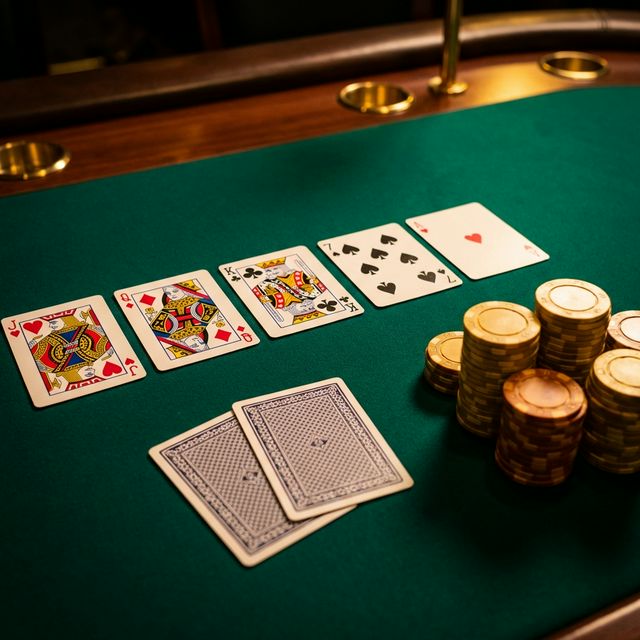
The dealer burns one card (discards it) and deals three community cards face up in the center. All players use these shared cards. A betting round follows, starting with the first active player left of the button.
5. The Turn
The dealer burns another card and deals a fourth community card. Another betting round follows.
6. The River
The dealer burns one last card and deals the fifth and final community card. Final betting round.
7. Showdown

If two or more players remain, they reveal their hole cards. The best five-card hand (using any combination of hole cards and community cards) wins the pot.
The Three Betting Formats
Texas Hold'em can be played in three different betting structures:
No-Limit Hold'em (NL)
The most popular format. You can bet any amount from the minimum raise up to your entire chip stack at any time. This is the format used in most major tournaments and the game that creates the dramatic all-in moments you see on TV.
Why it's popular:
> Pro Tip: In no-limit, a single mistake can cost you your entire stack. Position and hand selection matter more than in other formats.
Pot-Limit Hold'em (PL)
Middle ground. You can bet any amount up to the current size of the pot. Less common in Hold'em (more popular in Omaha), but still played in some home games.
Calculating pot-limit bets:
If the pot is $100 and you want to raise, the maximum is:
Fixed-Limit Hold'em (FL)
The original format. Bets and raises are fixed at predetermined amounts. Pre-flop and flop bets are the "small bet," turn and river are the "big bet" (typically double the small bet).
Example:
In a $2/$4 game:
Why it's less popular now:
Building Your Best Hand
You make your best five-card poker hand using any combination of your two hole cards and the five community cards:
Examples:
Hole cards: A♠ K♠
Board: K♥ K♦ 7♣ 3♠ 2♥
Your hand: Three kings (K♠ K♥ K♦) with ace-seven kickers
Hole cards: 9♣ 8♣
Board: A♠ K♠ Q♠ J♠ 10♠
Your hand: Broadway straight (everyone has this — you're playing the board)
Basic Strategy for Beginners
Pre-Flop
Post-Flop
General Principles
Why Texas Hold'em Became #1
The WSOP Effect
The World Series of Poker switched to No-Limit Hold'em as the Main Event format in the 1970s. The game's balance of luck and skill made it perfect for TV.
The Moneymaker Boom
In 2003, amateur player Chris Moneymaker won the WSOP Main Event after qualifying online for $86. This "everyman wins millions" story sparked a global poker explosion.
Perfect for Television
Hold'em is uniquely TV-friendly:
Optimal Complexity
Common Beginner Mistakes
Playing too many hands: Just because you can play 7-2 doesn't mean you should. Fold trash.
Limping instead of raising: Limping (calling the big blind) telegraphs weakness. If your hand is worth playing, it's usually worth raising.
Calling too much: Calling is often the worst option. Either raise (take control) or fold (cut losses).
Ignoring position: The same hand that's a raise on the button is a fold under the gun.
Chasing without odds: Calling with a gutshot straight draw when you're getting 3:1 pot odds is a long-term money loser.
Quick Reference: Key Terminology
| Term | Meaning |
|------|--------|
| Flop | The first three community cards |
| Turn / Fourth Street | The fourth community card |
| River / Fifth Street | The fifth and final community card |
| The Nuts | The best possible hand given the board |
| Drawing Dead | Drawing to a hand that can't win even if it hits |
| Bad Beat | Losing with a very strong hand to an even stronger hand |
| Cooler | An unavoidable big pot where both players have huge hands |
Wrapping Up
Texas Hold'em is the perfect poker game for home players and professionals alike. It's easy to learn but offers endless strategic depth. The no-limit format creates maximum drama and lets skilled players maximize their edge. Whether you're playing a casual $10 home game or grinding online for serious money, Hold'em rewards study, discipline, and psychological insight. Master this game, and you'll never run out of opponents eager to play with you.

