

Understanding Poker Hand Rankings
Every poker player must know the hand rankings cold — they're the foundation of the entire game. Whether you're playing Texas Hold'em, Omaha, or any other poker variant, these rankings remain the same. From the unbeatable royal flush to the humble high card, understanding the hierarchy and relative strength of each hand is essential for making profitable decisions at the table.
The Complete Rankings
1. Royal Flush — The Unbeatable Hand
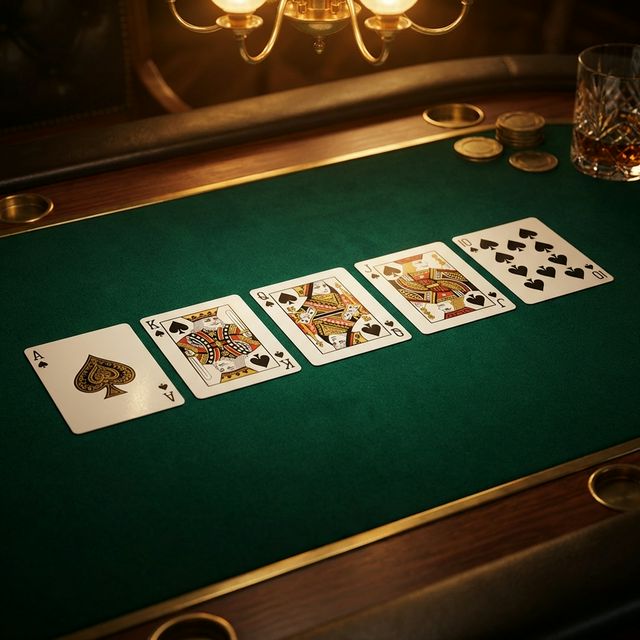
The royal flush is the absolute best hand in poker. It's a straight flush consisting of A♠ K♠ Q♠ J♠ 10♠ — all of the same suit. This hand cannot be beaten, only tied by another royal flush.
Probability: Approximately 0.000154% (1 in 649,740 hands)
Strategy tip: When you hit a royal flush, your only concern is maximizing value. Bet aggressively but not so fast that you scare everyone away. Check-raising is often the best play to build the pot.
2. Straight Flush
Any five consecutive cards of the same suit that aren't a royal flush. For example: 9♥ 8♥ 7♥ 6♥ 5♥. The highest card determines the strength — a king-high straight flush beats a queen-high straight flush.
Probability: Approximately 0.00139% (1 in 72,193 hands)
Strategy tip: Straight flushes are extremely rare but extremely powerful. Like a royal flush, focus on extracting maximum value. Be aware of potential higher straight flushes on the board.
3. Four of a Kind (Quads)
Four cards of the same rank: 8♠ 8♥ 8♦ 8♣ A♠. The higher the quads, the better — four aces beats four kings. The fifth card (the "kicker") only matters if two players both have the same four of a kind, which is rare.
Probability: Approximately 0.024% (1 in 4,165 hands)
Strategy tip: Four of a kind is a monster hand. Players often underestimate how strong it is. Unless the board is extremely coordinated (four to a straight flush), you should be willing to commit your entire stack.
4. Full House (Boat)

Three of a kind plus a pair: K♠ K♥ K♦ 8♣ 8♠. When comparing full houses, the three of a kind determines the winner first — a full house with three kings beats a full house with three queens, regardless of the pair. The pair is the tiebreaker if the trips are equal.
Probability: Approximately 0.14% (1 in 694 hands)
Strategy tip: Full houses are strong hands that win big pots. Be cautious when the board pairs on the river and you don't have the full house — your opponent might. Conversely, when you flop a full house, play it fast to build the pot.
5. Flush

Five cards of the same suit, not in sequence: K♥ J♥ 9♥ 7♥ 4♥. If multiple players have a flush, the highest card wins. If those are equal, compare the second-highest, and so on.
Probability: Approximately 0.20% (1 in 508 hands)
Strategy tip: Flushes are powerful hands, but they can be tricky. A low flush (say, 8-high) can lose to a higher flush. Pay attention to the texture of the board — if three of the same suit are showing, someone else might have a bigger flush.
6. Straight
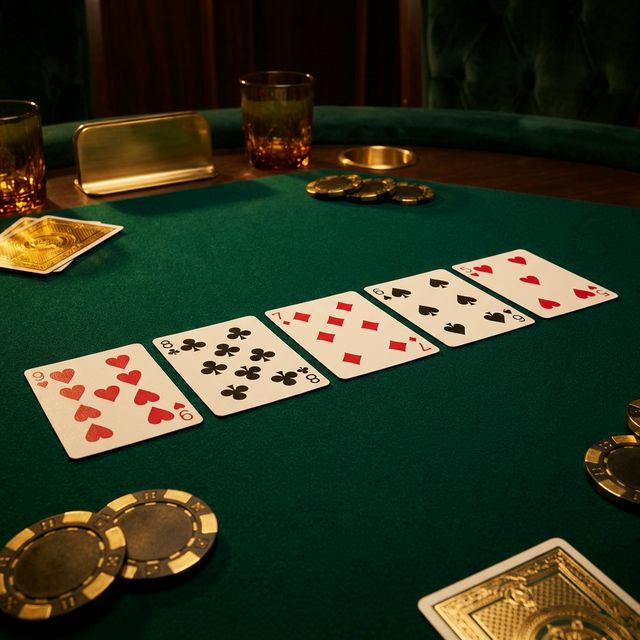
Five consecutive cards of mixed suits: 9♥ 8♣ 7♦ 6♠ 5♥. The ace can be high (A-K-Q-J-10) or low (5-4-3-2-A), but cannot wrap around (K-A-2-3-4 is not a valid straight).
Probability: Approximately 0.39% (1 in 255 hands)
Strategy tip: Straights are vulnerable to flushes and full houses. On a three-flush board, proceed with caution. Also, beware of the "dummy end" of the straight — if the board shows 8-7-6, your 5-4 makes a straight, but anyone with 10-9 has a higher one.
7. Three of a Kind (Trips or Set)
Three cards of the same rank: Q♠ Q♥ Q♦ 9♣ 5♠. A "set" refers to three of a kind made with a pocket pair (you have Q♠ Q♥ and one Q comes on the board), while "trips" means one card in your hand matches two on the board (you have Q♠ and two Queens appear).
Probability: Approximately 2.11% (1 in 47 hands)
Strategy tip: Sets are much more disguised than trips and tend to win bigger pots. When you have trips, be aware that opponents may have better kickers or even a full house.
8. Two Pair
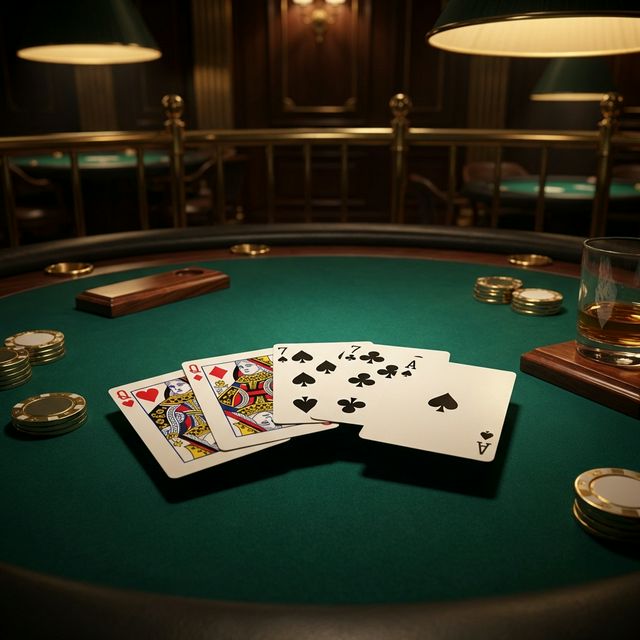
Two different pairs: Q♥ Q♦ 7♠ 7♣ A♠. The higher pair determines the winner first, then the second pair, then the kicker. Queens and sevens beats jacks and tens.
Probability: Approximately 4.75% (1 in 21 hands)
Strategy tip: Two pair is a decent hand but vulnerable to straights, flushes, and full houses. Be cautious on wet boards (many connected or suited cards). Top two pair is a strong hand worth betting for value.
9. One Pair
Two cards of the same rank: A♠ A♥ K♦ 8♣ 3♠. The pair's rank matters first, then the three kickers in descending order. Aces with a king kicker beats aces with a queen kicker.
Probability: Approximately 42.26% (about 2 in 5 hands)
Strategy tip: One pair is the most common made hand. A big pair (aces or kings) can win, but proceed carefully on scary boards. Kickers matter immensely — ace-king is significantly stronger than ace-deuce.
10. High Card
No pair, no straight, no flush: A♠ K♦ 10♥ 7♣ 4♠. The highest card plays, with remaining cards serving as kickers in order.
Probability: Approximately 50.12% (about half of all hands)
Strategy tip: High card is only relevant when no one has made a pair or better. This often happens when the board is dry and both players miss. Ace-high can sometimes win at showdown, but don't overvalue it.
Tie-Breakers and Kickers
When two players have the same hand type, kickers determine the winner. For example, if both players have a pair of kings, whoever has the highest side card (kicker) wins. If the top three kickers are also equal, the pot is split.
> Pro Tip: Always pay attention to kickers. A-K is far superior to A-5 because when you hit your ace, your king kicker dominates opponents with weaker aces.
Hands That Get Confused
Beginners often mix up these pairs:
Reading the Board
In Texas Hold'em, you make your best five-card hand using any combination of your two hole cards and the five community cards. Sometimes the best hand is entirely on the board (e.g., a straight showing on the community cards with no flush or full house possible). In that case, everyone still in the hand splits the pot.
Wrapping Up
Mastering hand rankings is non-negotiable. Drill these until they're automatic. When you're deep in a hand with money on the line, you need to know instantly whether your straight beats their two pair, or if that paired board means your flush just got crushed by a full house. Know your rankings, know your kickers, and know when to fold — even strong hands lose to stronger ones.

