

The Math That Wins Pots
Pot odds are the single most important mathematical concept in poker. They answer the question: "Should I call this bet?" If you can calculate pot odds and compare them to your hand odds, you'll make profitable decisions every time. This guide breaks down the math in plain English, with real examples you'll face at the table.
What Are Pot Odds?

Definition: The ratio of the current pot size to the cost of a call.
Pot odds tell you how much you're risking vs. how much you stand to win.
Formula:
Pot Odds = Pot Size : Call Amount
Example 1: Basic Pot Odds Calculation
Pot Odds = 120:20 = 6:1
This means you're risking $20 to win $120. You're getting 6-to-1 odds on your call.
What Are Hand Odds (Outs)?
Hand odds are your chances of making your hand.
To calculate hand odds:
Common Drawing Hands and Outs
| Draw Type | Outs | Flop → Turn | Flop → River | Odds |
|-----------|------|-------------|--------------|------|
| Flush draw | 9 | 19% | 35% | ~2:1 (flop → river) |
| Open-ended straight draw | 8 | 17% | 32% | ~2.2:1 |
| Gutshot straight draw | 4 | 8.5% | 16.5% | ~5:1 |
| Two overcards | 6 | 13% | 24% | ~3:1 |
| Set to full house/quads | 7 | 15% | 28% | ~2.5:1 |
The Rule of 2 and 4
Quick estimation for hand odds:
#### Example: Flush Draw
You have A♠ 10♠. Flop = K♠ 7♠ 2♦.
Comparing Pot Odds to Hand Odds
Here's the decision tree:
- If pot odds > hand odds → CALL (profitable long-term)
- If pot odds < hand odds → FOLD (unprofitable long-term)
Example 2: Flush Draw Decision
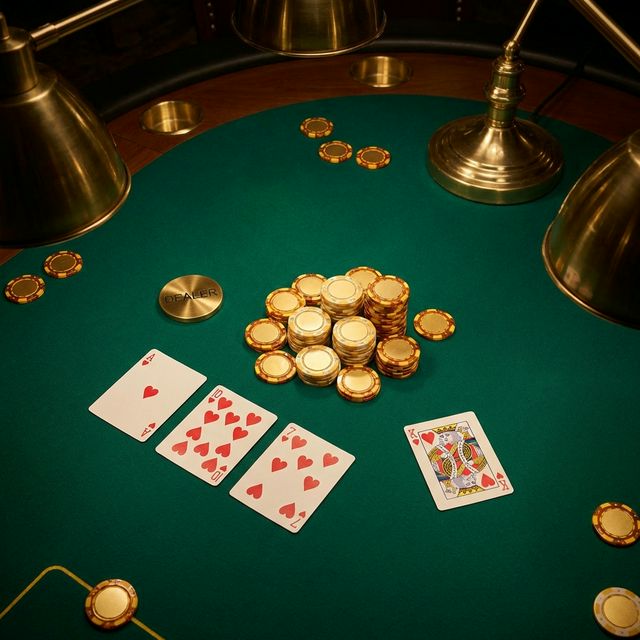
Situation:
Step 1: Pot Odds
Pot = $60 + $20 = $80
Call = $20
Pot Odds = 80:20 = 4:1
Step 2: Hand Odds
Outs = 9 hearts
Flop → River = 9 x 4 = 36% = ~2:1
Step 3: Compare
Pot odds (4:1) > Hand odds (2:1)
Decision: CALL
You're getting 4-to-1, but you only need 2-to-1 to break even. This is a profitable call.
Example 3: Gutshot Decision
Situation:
Step 1: Pot Odds
Pot = $40 + $40 = $80
Call = $40
Pot Odds = 80:40 = 2:1
Step 2: Hand Odds
Outs = 4 (any 6 or 10 makes a straight)
Flop → River = 4 x 4 = 16% = ~5:1
Step 3: Compare
Pot odds (2:1) < Hand odds (5:1)
Decision: FOLD
You're only getting 2-to-1, but you need 5-to-1 to break even. This is an unprofitable call.
Implied Odds: Future Betting
Implied odds account for money you expect to win on future streets if you hit your hand.
When implied odds matter:
Example: Calling with Bad Pot Odds
Situation:
Pot Odds: 60:30 = 2:1
Hand Odds: 9 outs (flush draw) = ~2:1
Pot odds barely justify a call. But:
Implied odds: If you hit your flush, your opponent (with top pair or two pair) might call a big bet on the turn or river. You could win an extra $100-200.
Decision: Call, because implied odds make it profitable.
Reverse Implied Odds: When You're Drawing Dead
Reverse implied odds = situations where hitting your draw still loses.
Example: Non-Nut Flush Draw
You have 10♠ 8♠. Board = K♠ Q♠ 2♦. You're drawing to a flush.
Problem: If another spade comes, someone with A♠ beats you. You hit your draw but lose a massive pot.
Lesson: Drawing to non-nut hands has reverse implied odds. Fold more often.
Pot Odds in Practice: Quick Mental Math
You don't need a calculator.
Shortcut:
If your outs x 4 (flop → river) or x 2 (turn → river) give you more equity than required, call.
Quick Reference
| Pot Odds | % Equity Needed |
|----------|------------------|
| 5:1 | 17% |
| 4:1 | 20% |
| 3:1 | 25% |
| 2:1 | 33% |
| 1:1 (even money) | 50% |
Multi-Way Pots
If multiple opponents are in the hand, your pot odds improve (bigger pot), but your hand odds get worse (more ways to lose).
General rule: Drawing hands (flushes, straights) improve in multi-way pots. Made hands (top pair) get weaker.
Common Mistakes
Counting outs incorrectly: Don't count outs that give your opponent a better hand. Example: You have J-10, board is K-9-2, you're drawing to a queen for a straight — but if your opponent has AQ, the queen gives them two pair.
Forgetting about future bets: Pot odds assume no more betting. If your opponent can bet again on the turn, you need better odds to call the flop.
Ignoring opponent ranges: If your opponent only bets when they have a monster, your implied odds shrink (they won't pay you off).
Wrapping Up
Pot odds turn poker from guessing into math. Count the pot. Count the bet. Calculate the ratio. Compare to your outs. Call when you're getting the right price, fold when you're not. It's that simple. Master pot odds and you'll stop making crying calls that bleed chips. You'll fold bad draws and call good ones. You'll win money in the long run, even when you miss in the short run. The math doesn't lie.

